Wx Feature · Attentive
Why your doorknob bites.
Winter's hidden drought is inside your house.
Winter at home · 3 min read
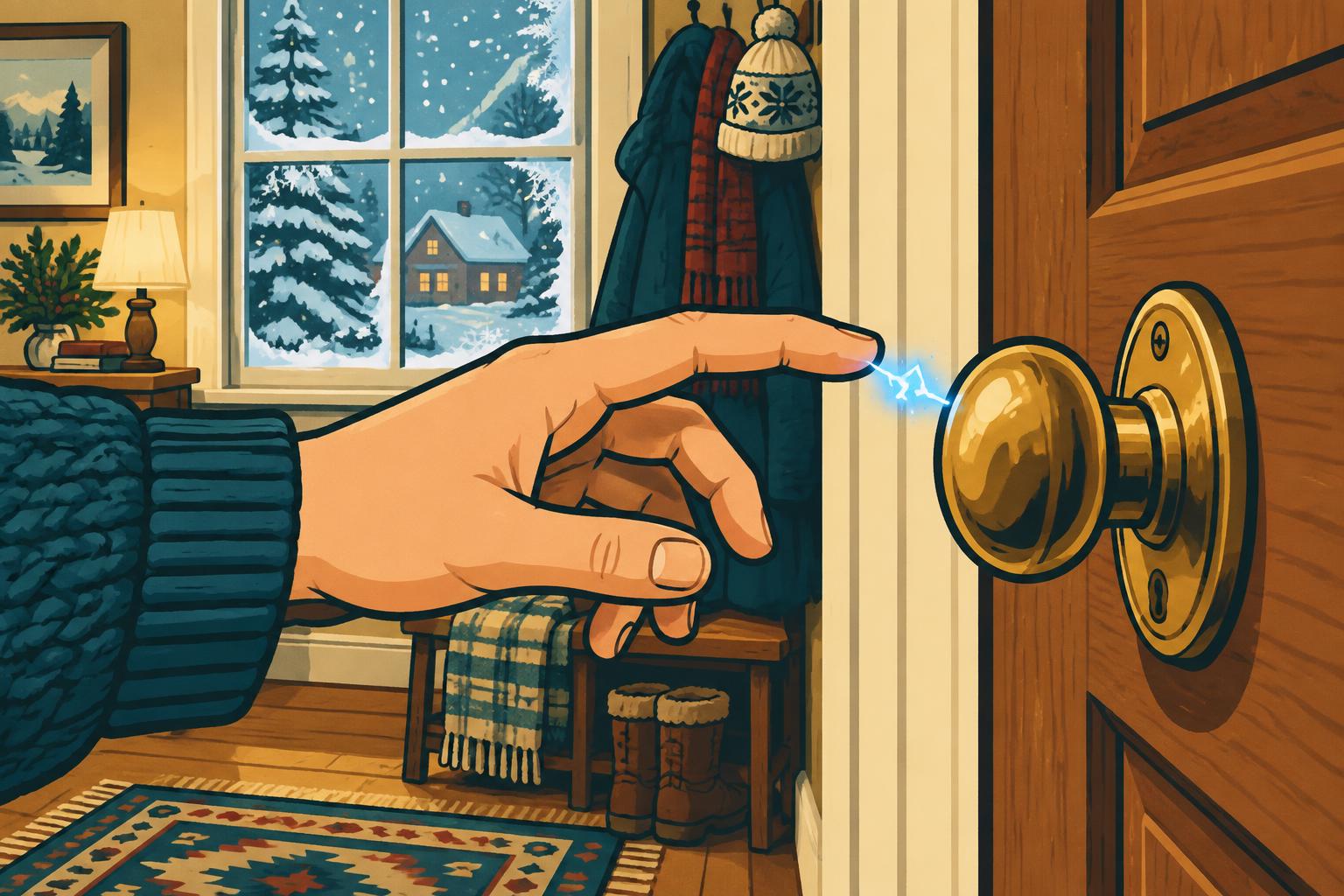
You reach for the doorknob and snap: a tiny blue spark and a jolt up your arm. It happens every winter, and most of us blame the carpet or our socks. The real culprit is the forecast.
Here's the strange part. In winter, the air inside your house can be as dry as a desert. Cold air can only hold a little water vapor. When 20°F air leaks into your home and the furnace warms it to 70°F, the amount of water in it doesn't change, but the amount it could hold goes up almost seven times. A raw morning that measures 70% humidity outside can become about 10% humidity in your living room.
Same air, two temperatures
Outside
20°F
70% humidity
Feels damp
your furnace
Inside
70°F
~10% humidity
Desert-dry
Heating air doesn't remove water. It gives the water more room, so the air gets thirstier.
A lightning bolt at your fingertip
Every step across a rug rubs a few electrons loose, and you carry that extra charge with you. In humid air, a thin film of moisture on your skin, clothes and nearly every surface lets the charge quietly leak away. In dry air, it has nowhere to go. It keeps building until you reach for something metal, and then it all jumps the gap at once.
That spark is lightning in miniature.
Inside a thunderstorm, collisions among ice particles help separate charge. When the electric field grows strong enough, a flash can cross the gap. Yours is just a lot shorter.
The shock meter: example voltages after walking across carpet
Dry air (10–20% humidity)
Up to 35,000 V
Humid air (65–90% humidity)
About 1,500 V
The tick on each bar marks about 3,000 V — roughly where many people begin to feel a shock.
Big voltage, tiny current. It stings, but it's harmless to you.
Where the spark matters more
You need a few thousand volts before you feel anything. A computer chip can be damaged by far less, from a spark too small to notice. That's why electronics factories control their humidity and clip their workers to the ground with wrist straps.
The same spark is the reason for a gas-pump rule most people ignore. In cold, dry weather, climbing back into your car while it fuels can build up charge on the seat, and the first thing you touch on the way back is the nozzle.
At the pump
Stay outside the car while you pump.
If you do get back in, touch bare metal on the car door before you touch the nozzle again.
Try this week
1
Check your indoor humidity
Many thermostats show it, and a basic hygrometer costs about $10. Between 30% and 50% is comfortable. Below 30%, static shocks become more likely.
2
Use the key trick
Hold a house key and touch the doorknob with it first. The spark jumps from the key, not your finger.
3
Check two numbers
The next time you get zapped, check two numbers: the dew point in your weather app and the indoor humidity on your thermostat or hygrometer. Check again after the next front. Did they both drop?
4
Fight back
A humidifier, lotion on your hands and cotton instead of wool or fleece all help the charge leak away before it bites.
Something to notice
The weather doesn't stop at your front door
Every cold front that sweeps through dries out the air inside your house too, and the doorknob is how it tells you. This week, be attentive: the next time you get zapped, look at the thermometer outside.
The colder it is out there, the drier it is in here.
Next week
On Thanksgiving morning, millions of people watch a weather decision without knowing it. The giant parade balloons only fly if the wind allows, and we'll show you the exact numbers.