Wx Feature · Weather & sport
Too cold to play outside. So he invented basketball.
Before the brackets, the buzzer-beaters, and the hoop above your driveway, there was a winter problem: a room full of people who needed something better to do.
December 1891 · Springfield, Massachusetts · 3 min read
From blizzard to Olympics
December 1891
A blizzard traps a class indoors
Days later
Naismith gets the assignment
First game
Two peach baskets, ten feet up
Jan 15, 1892
The rules appear in The Triangle
1936
An Olympic medal sport
Winter brought them inside. Boredom took over.
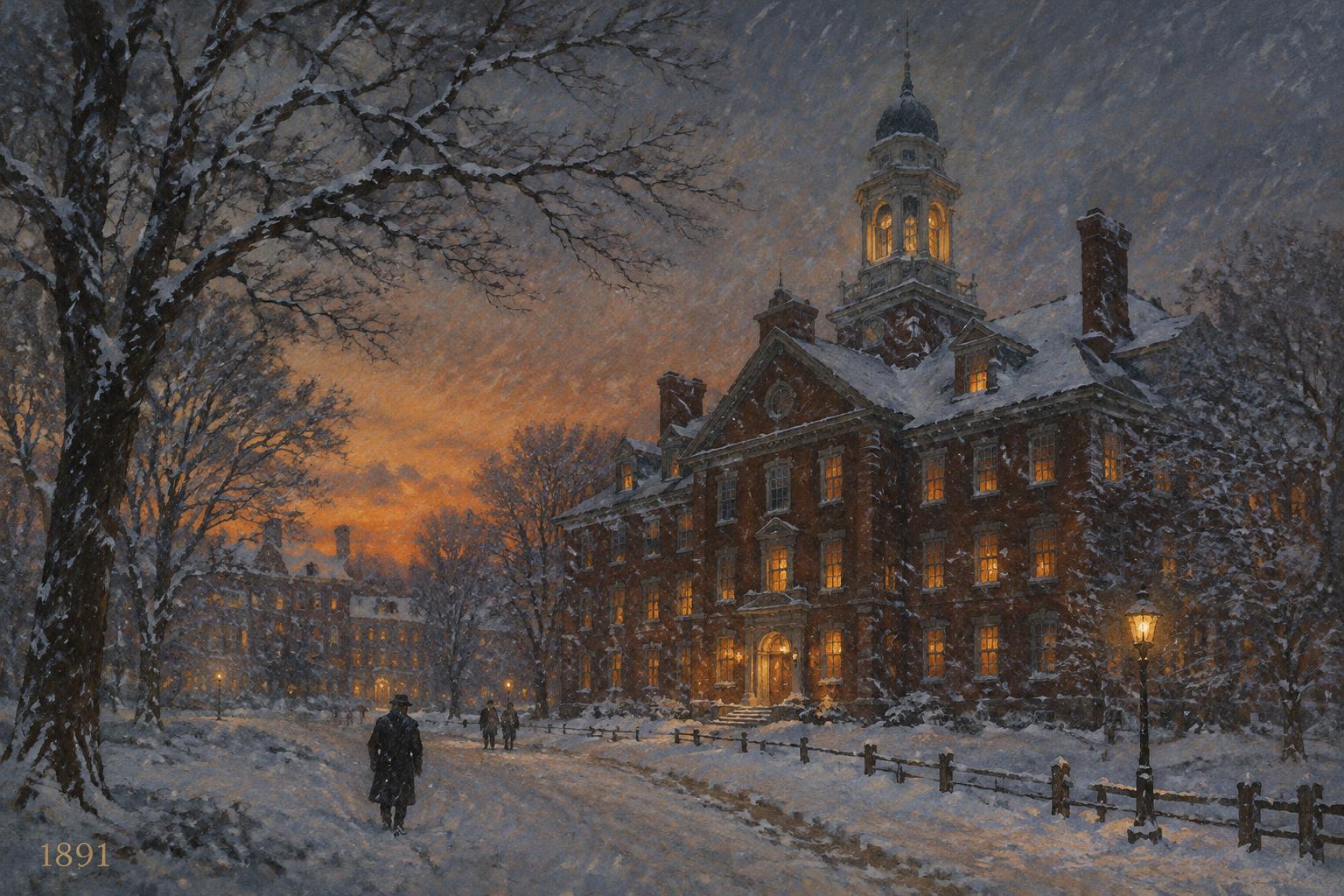
At the school now known as Springfield College, the football season had ended. The students' energy hadn't.
Then the weather made it worse. Years later, Naismith remembered it plainly:
"We had a real New England blizzard."
For days, the students couldn't go outdoors. So they started roughhousing in the halls.
Indoor exercise meant marching, calisthenics, and gymnasium equipment. The students weren't enthusiastic. Two instructors had already struggled to engage the class.
Watch the story · 0:34
The blizzard that made a game
In 34 seconds: the snowbound class, the assignment, and the peach baskets that went up ten feet high.
The assignment
Physical education superintendent Luther Gulick handed the problem to James Naismith: come up with a game that would keep them interested through the New England winter.
It needed to work indoors, involve a group, and provide real exercise. Moving a full-contact outdoor sport into a small gym wasn't going to do it.
Winter had changed the available space. Naismith needed to change the game.
He asked for boxes. He got baskets.
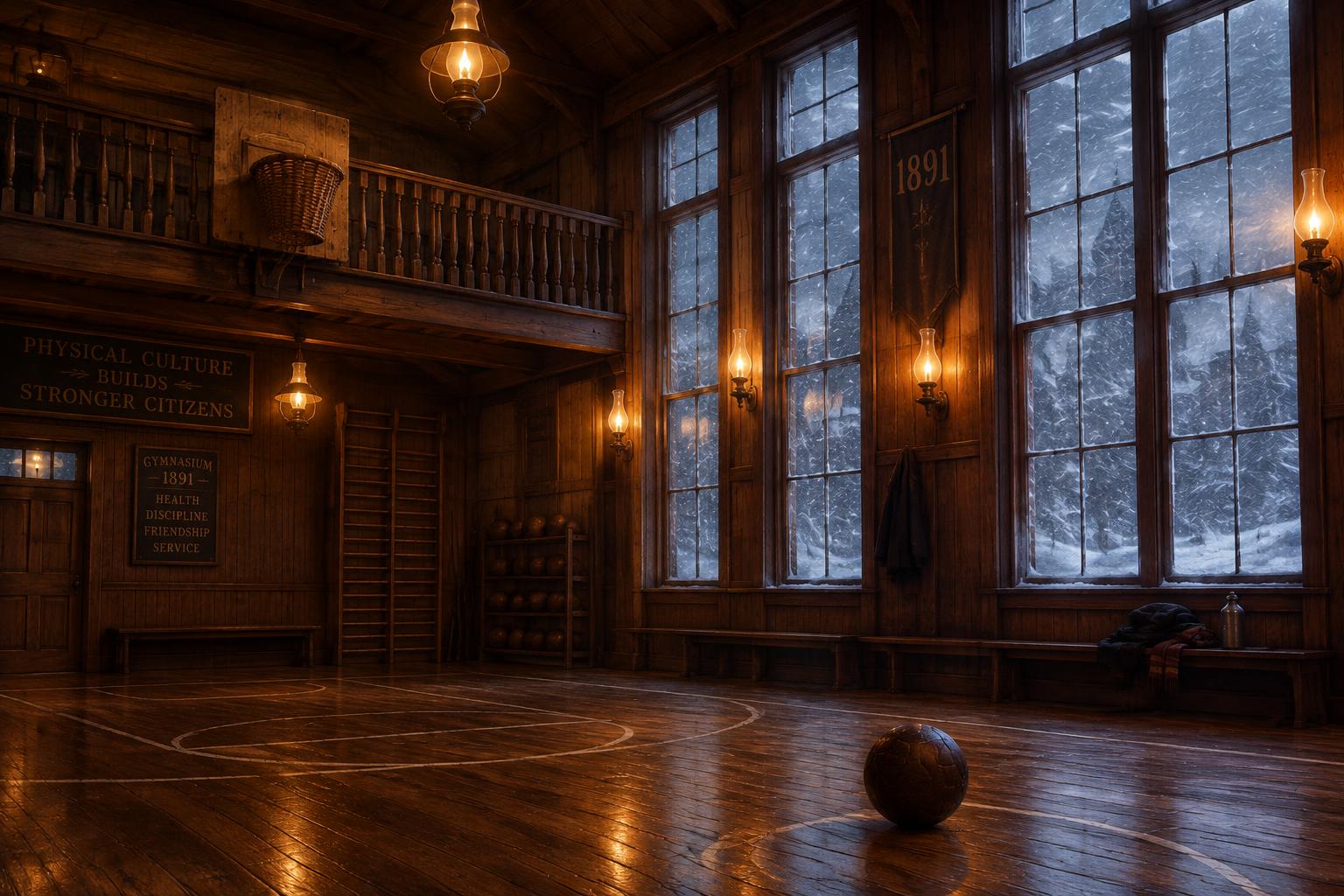
Naismith went to the school janitor looking for two boxes to use as goals. The janitor had peach baskets.
They went up at opposite ends of the gym, attached to the balcony rail. That rail happened to be ten feet above the floor.
More than a century later, that is still the height everyone is shooting for.
10 ft
Height of the balcony rail. Still the height of every hoop.
18
Students. Two teams of nine.
13
Original rules, written after a messy first try.
The equipment was wonderfully ordinary: two baskets, a soccer ball, and a room. There was one practical inconvenience.
The baskets still had bottoms. Every successful shot created another job: getting the ball back.
The first attempt needed work
The neat version of an invention story makes it sound finished from the beginning. Naismith's own account was messier.
In 1939, months before he died, he told the story on a New York radio show. It may be the only recording of his voice that exists.
He blew a whistle, and the first game began. It did not go well. Players tackled, kicked, and punched. Before he could pull them apart, one was knocked out, several had black eyes, and one had a dislocated shoulder.
His explanation was simple. He hadn't given them enough rules, and he called that his big mistake.
So he wrote more. The most important new rule was no running with the ball, which put an end to the tackling. His original thirteen rules also barred pushing, tripping, and striking opponents.
The next time they played, no one got hurt.
That version doesn't quite match the traditional story, in which the rules came before the first game. But it fits how the game actually grew: try it, see what happens, change what doesn't work. The familiar dribble came later.
A winter solution that traveled
The game spread through students and the YMCA network. Its rules appeared in The Triangle, the school's newspaper, on January 15, 1892, giving people elsewhere a way to try it themselves.
By 1936, men's basketball was an Olympic medal sport. Naismith traveled to Berlin to see it.
Within his lifetime, an assignment to occupy one restless class had become an international game. A blizzard trapped a class indoors, and their restlessness needed somewhere to go. Human curiosity supplied the rest.
Something to notice
The weather behind the hoop
The next time you hear a basketball bouncing down the street, there's a winter story in that sound.
Someone had a snowbound room, a ball, and the wrong kind of baskets. He tried something. When it got messy, he adjusted.
Looking back, Naismith summed up where those adjustments led:
"We had a fine, clean sport."
Winter brought them indoors. What happened next gave the world another reason to play.